
My name is Yue Li (李越). I am currently a master’s student at the School of Computer Science and Technology, East China Normal University, under the supervision of Professor Linlin Wang. My primary collaborator, Dr. Xin Yi, provides me with invaluable guidance and support throughout my studies. Prior to this, I earned my BEng degree from Xiangtan University, where I was mentored by Associate Professor Xuan Lin.
In 2026, I completed a series of industry internships across Shanghai and Hangzhou. I began at the Shanghai Artificial Intelligence Laboratory on the Xuhui West Bund, where I enjoyed a comfortable, memorable, and truly wonderful few months with a supportive mentor and team. I then joined Ant Group in Hangzhou, where I was surrounded by a friendly team and a rich technical atmosphere. In early September 2026, I relocated to Ant Group’s Lujiazui office in Shanghai, and closed this chapter at the end of the month.
My research interests mainly lie in Model Post-Training (current focus) and Trustworthy AI. I have published 5+ papers 
🔥 News
- 2026.09: 🏆 I'm honored to receive the BYD Scholarship
- 2026.09: 🎉 Two papers were accepted to AACL-IJCNLP 2026.
- 2026.09: 💼 I moved to Ant Group's Lujiazui office in Shanghai.
- 2026.06: 💼 I joined Ant Group as a research intern in Hangzhou.
- 2026.05: 🎉 My first-authored paper was accepted to KDD 2026!
- 2026.04: 💼 I joined Shanghai AI Lab as a research intern in Shanghai.
-
📰 Earlier News
- 2025.10: 🏆 I'm honored to receive the East China Normal University Outstanding Academic Scholarship (First Prize).
- 2025.05: 🎉 My first-authored paper was accepted to ACL 2025!
📝 Publications
⚙️ Model Post-Training
Pruning
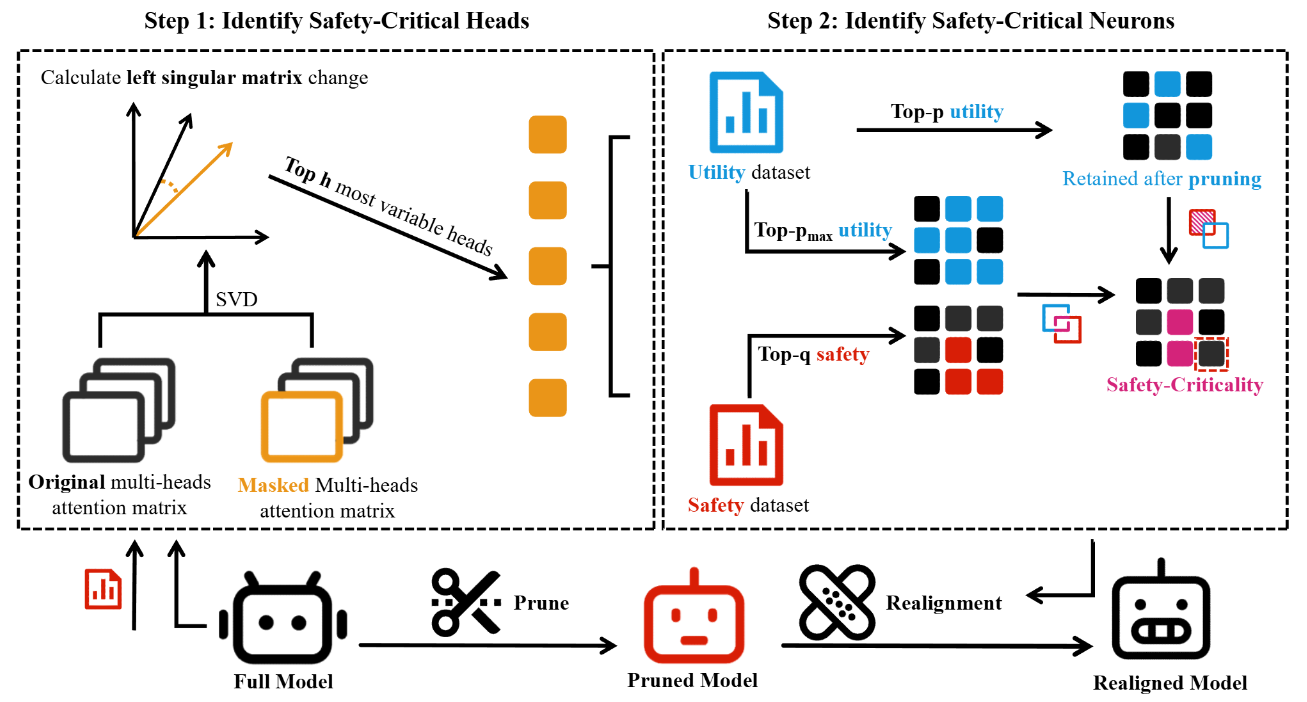
Hierarchical Safety Realignment: Lightweight Restoration of Safety in Pruned Large Vision-Language Models \ Yue Li*, Xin Yi*, Dongsheng Shi, Gerard de Melo, Xiaoling Wang, Linlin Wang†
ArXiv | Project | ACL Anthology | Poster
- The current pruning methods will lead to a significant degradation of the model’s safety at a higher sparsity.
- The HSR (Hierarchical Safety Realignment) method we proposed can achieve safety realignment for the pruned model by restoring only a very small number of neurons. HSR is effective for both LLM and LVLM.
Fine-Tuning
-
ESWA 2026Latent-space adversarial training with post-aware calibration for defending large language models against jailbreak attacks, Xin Yi, Yue Li, Dongsheng Shi, Linlin Wang†, Xiaoling Wang, Liang He -
ArXiv 2025Unified defense for large language models against jailbreak and fine-tuning attacks in education, Xin Yi, Yue Li, Dongsheng Shi, Linlin Wang†, Xiaoling Wang, Liang He
Reinforcement Learning
ArXiv 2026Reinforcement Learning for Large Language Model Selective Evidence Adoption from Contaminated Retrieval Results, Yanyu Chen*, Yue Li*, Yongyi Cui, Dongsheng Shi, Lichang Dai†
🎯 Trustworthy AI
Watermarking
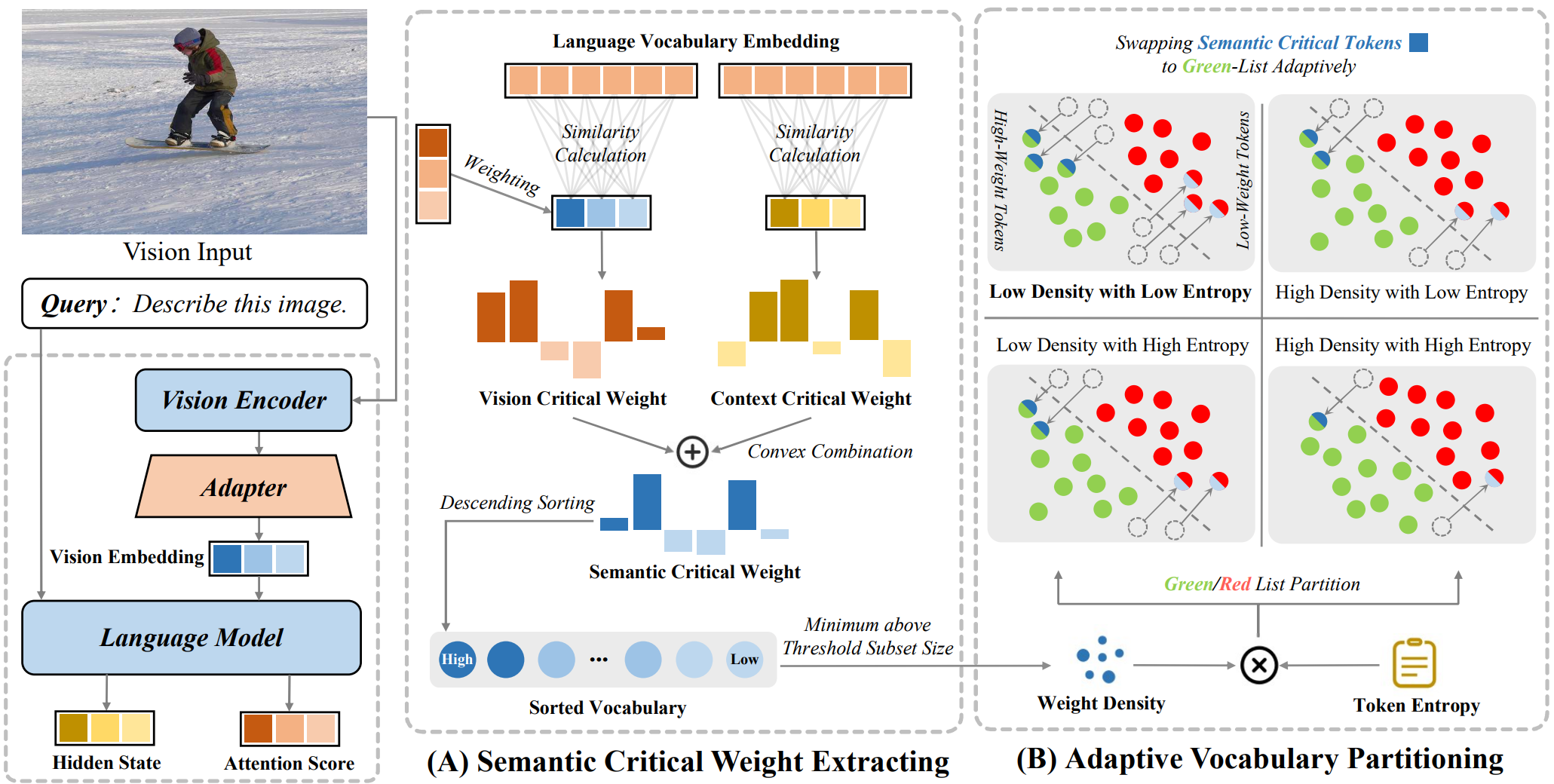
AGMark: Attention-Guided Dynamic Watermarking for Large Vision-Language Models \ Yue Li*, Xin Yi*, Dongsheng Shi, Yongyi Cui, Gerard de Melo, Linlin Wang†.
ArXiv | Project | ACM Digital Library | Poster
- We propose AGMark, a watermarking method for LVLMs that follows the red–green token partitioning paradigm.
- At each generation step, AGmark identifies candidate token weights and determines the protected token set size, effectively mitigating the trade-off between text quality and watermark detectability.
KBS 2025Unified Attacks to Large Language Model Watermarks: Spoofing and Scrubbing in Unauthorized Knowledge Distillation, Xin Yi, Yue Li, Shunfan Zheng, Linlin Wang†, Xiaoling Wang, Liang He
Fingerprinting
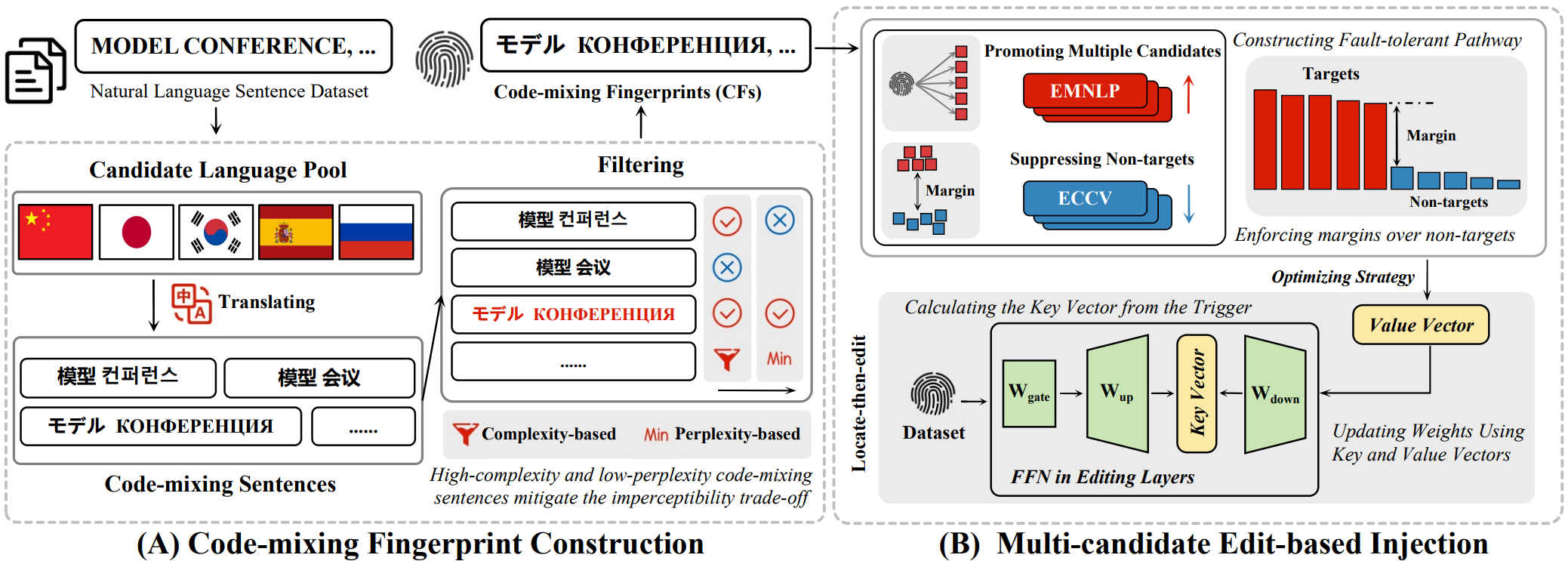
From Construction to Injection: Edit-Based Fingerprints for Large Language Models \ Yue Li*, Xin Yi*, Dongsheng Shi, Yongyi Cui, Gerard de Melo, Linlin Wang†.
ArXiv |
- We include CF, a code-mixing fingerprint paradigm, and MCEdit, a knowledge-editing-based multi-candidate fingerprint injection method.
- Our approach achieves persistent detectability, preserves utility, and remains imperceptible against accidental activation and perplexity-based filters.
ArXiv 2026Construction-Driven Injection: Linguistically-Grounded Edit-Based Code-Mixing Fingerprints for Large Language Models, Yongyi Cui*, Yue Li*, Tianbao Jiang, Xin Yi†
📦 Others
Medical Agent Systems
-
AACL-IJCNLP 2026 Findings (Oral)EMR: Self-Evolving Medical Multi-Agent System via Experience Mining and Reuse, Dongsheng Shi, Yue Li, Xin Yi, Linlin Wang† -
ArXiv 2026SURGENT: A Surgical Multi-Agent Assistance System Across the Perioperative Workflow, Dongsheng Shi, Yue Li, Xin Yi, Huawei Feng, Linlin Wang†
Benchmarks
-
ESWA 2026Benchmarking Large Language Models for End-to-End Clinical Support in Traditional Chinese Medicine, Dongsheng Shi, Xin Yi, Yue Li, Linlin Wang† -
ArXiv 2026Evaluating LLMs in Database Scenarios: A Lifecycle Benchmark for Assessing Their Potential in Core Database Tasks, Shunfan Zheng, Dongsheng Shi, Yue Li, Xin Yi, Linlin Wang†, Gerard de Melo
💼 Internships

- Duration: June 2026 – September 2026
- Mentor: Qiu Zhi
- Focus: Intrinsic safety of LLMs, with a particular emphasis on agent tool calling, including agentic reinforcement learning and on-policy distillation.

- Duration: April 2026 – June 2026
- Mentor: Jie Li
- Focus: LLM/Agent Safety, including participation in the construction of the OpenClaw evaluation benchmark and support for safety testing of the Intern series models.
🏆 Honors and Awards
- 2026.09, BYD Scholarship
- 2025.10, East China Normal University Outstanding Academic Scholarship (First Prize)
- 2023.05, The 2023 China College Student Programming Competition (CCPC) National Invitational (Hunan), Silver Medal
- 2022.04, The 46th International Collegiate Programming Contest (ICPC) Asian Regional Competition (Kunming), Bronze Medal
🎓 Education
- 2024.09 - Present, Master of Engineering,
 East China Normal University, Shanghai.
 - 2020.09 - 2024.06, Bachelor of Engineering,
 Xiangtan University, Xiangtan.
📋 Academic Services
- The ACM Web Conference (The International World Wide Web Conference, WWW)
- Association for the Advancement of Artificial Intelligence (AAAI)
- IEEE/INNS International Joint Conference on Neural Networks (IJCNN)
- Association for Computational Linguistics Rolling Review (ARR)